

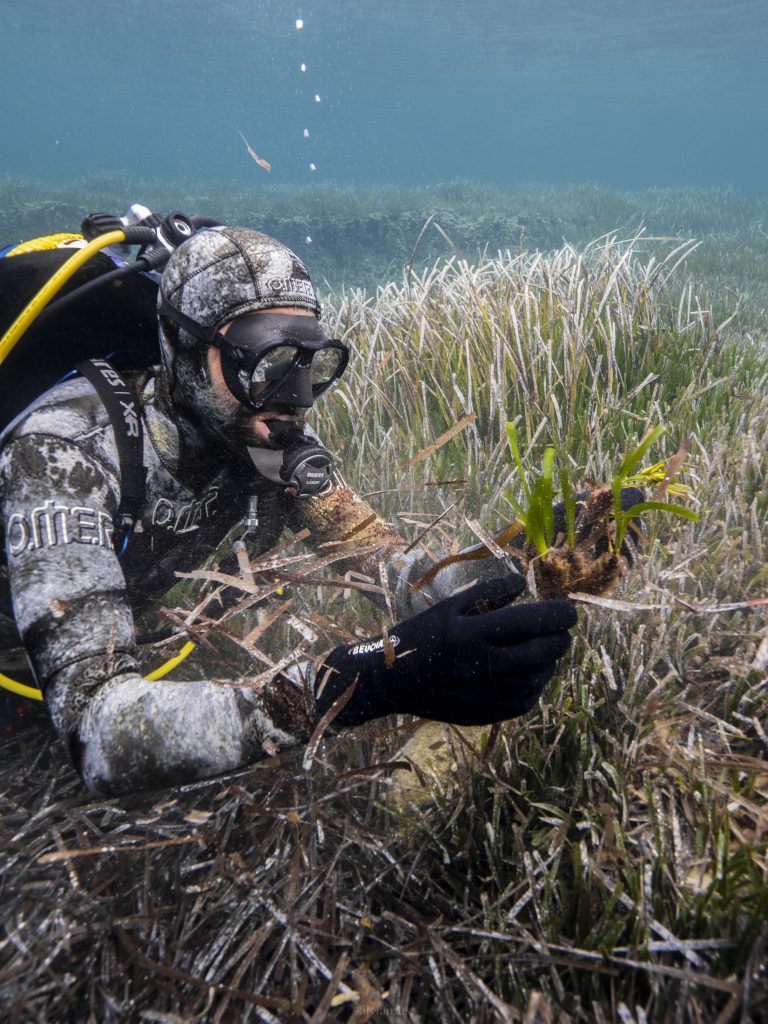
New collaborative article: New, more sustainable and cost-effective techniques for Posidonia restoration.
A team of researchers from the MedGardens initiative of the Cleanwave Foundation and the Mediterranean Institute for Advanced Studies (IMEDEA, CSIC-UIB) has identified more effective, cost-efficient, and environmentally friendly planting techniques to promote the recovery of seagrass meadows.
A study carried out by Dr. Gema Hernán, Laura Royo Marí, Tatí Benjumea Tesouro, Jose Escaño, and Dr. Fiona Tomas from IMEDEA (CSIC-UIB) and MedGardens (Cleanwave Foundation) analyses different replanting techniques for this emblematic Mediterranean plant. The research, conducted in the bays of Formentor and Portocolom (Mallorca), not only compares their ecological success, but also practical aspects such as cost, logistics, and environmental impact, identifying the most promising options to support the natural recovery of degraded seagrass meadows.
Posidonia: a threatened marine treasure
Posidonia oceanica, protected under European, Spanish, and Balearic legislation, forms one of the Mediterranean’s most valuable ecosystems. These underwater meadows act as true “blue lungs”: they produce oxygen, protect coastlines from erosion, and store large amounts of carbon, helping to mitigate climate change. However, human pressure, indiscriminate anchoring, pollution, and ocean warming have caused an alarming decline in these habitats.
Replanting: simpler and more effective techniques
The replanting of Posidonia oceanica fragments is considered a key tool for promoting the recovery of degraded meadows, although until now it has been costly and achieved limited success. This study compares, for the first time, different anchoring methods — metal gardening staples, bamboo sticks, larger staples, and handcrafted marès stone stakes — evaluating not only their ecological effectiveness, but also practical factors such as cost, supply, carbon footprint, and logistics.
After two years of monitoring, the results show that gardening staples and bamboo sticks are the most efficient and sustainable options, with survival rates of up to 94%, low cost, and reduced environmental impact. Larger staples, although they favour the growth of more developed fragments, present greater logistical limitations, as they require larger specimens that are harder to find and less cost-effective.
Overall, the simpler and lighter methods offer a promising pathway for scaling up restoration efforts without compromising ecological outcomes.
Our research demonstrates that restoring Posidonia oceanica meadows can be done in a more affordable and environmentally responsible way by integrating ecological, economic, and logistical criteria. This is essential for designing viable and sustainable long-term restoration projects,” the study authors highlight.
Towards comprehensive and sustainable recovery
This research is framed within the EU Nature Restoration Law and the United Nations Decade on Ecosystem Restoration (2021–2030), reinforcing the importance of carrying out these actions in a legal, responsible, and strategic manner. The study highlights the importance of long-term monitoring after planting, as the first years show slow growth dynamics and some loss of material. Even so, average survival after two years exceeds 80%, confirming the potential of these techniques in shallow and protected areas where Posidonia previously existed.
The research marks a step forward towards a more comprehensive approach to marine restoration, one that not only seeks to recover lost vegetation, but to do so efficiently, sustainably, and in ways that are adaptable to real working conditions at sea. This balanced approach between ecological success and practical feasibility lays the groundwork for future large-scale restoration actions across the Mediterranean and other coastal regions. Nevertheless, the researchers remind us that the best strategy will always be to conserve existing meadows before attempting to replant them.
Reference: Hernán G., Royo L., Benjumea T., Escaño J., Tomas F. (2025). Comparison of different anchoring techniques for seagrass (Posidonia oceanica) restoration. Marine Pollution Bulletin Link to the article.
